Health Data Management

CURRENT ISSUE April 06, 2007

Erickson Health Takes Long View with Technology

Health Data Management recognizes the efforts of nurses to drive I.T. adoption at a long-term care organization.

By Greg Gillespie, Associate Publisher/Editorial

Many long-term care providers are mom-and-pop organizations that operate a single facility on a shoestring budget. But even the largest chains still have made little use of automation. Most of these organizations, both large and small, have neither the time nor money to embark on automation efforts, even though their elderly patient populations need frequent, complex care, and the government requires reams of forms to be filled out on a regular basis for regulatory and reimbursement purposes.

Baltimore-based Erickson Health knew it would have to write a new chapter in long-term care automation when it embarked on an enterprisewide implementation of various electronic records systems for its skilled nursing, assisted living, physical therapy and home health facilities.

The linchpin to all these efforts is the automation of nursing documentation for all the various services Erickson Health offers, says Mark Erickson, COO and son of John Erickson, founder of the organization.

"Coordination of care is obviously much more complex for seniors because they have to see a number of different caregivers who are ordering treatments and medications for one problem but not addressing that patient's overall well-being," he says. "We needed to create a 'quarterback' that provides information on every aspect of that patient-their physical and cognitive condition, diet, activity level and so forth. And to automate to that degree you must have nurses involved in every step in the process."

The efforts by nurses at Erickson Health have earned the organization Health Data Management's 2nd Annual Nursing Information Technology Innovation Award.

The award recognizes innovation and excellence in using information technology in the field of nursing to directly improve the quality of care/patient safety and/or promote the effective use of nursing resources. More than 50 organizations submitted entries for this year's contest (see related story below).

Getting the house in order

Before Erickson Health went live with the nursing home EMR-the term it uses for the nursing documentation system-it had to set the stage for automation by standardizing nearly 60 forms used for documenting interactions with patients, says Beth Ann Muthig, R.N., senior director of clinical informatics, who was a project manager for the effort.

Erickson Health's 18 continuing care communities are campuses that provide a wide range of services for as many as 3,000 residents, some who live independently and others who live in assisted living facilities. The EMR project initially focused on seven of these locations.

In addition, residents often move between care settings. Some independent residents may have to be admitted to skilled nursing units, while others may have to be sent to area hospitals for acute care services.

The forms standardization effort involved communities in four states-Maryland, Michigan, New Jersey and Massachusetts. This first step was crucial to the project not only in terms of I.T., but in terms of staff buy-in, Muthig says. "Every community had its own forms for initial assessments and other common documentation, and while they looked alike they were different in what types of information was being collected and how it was being transcribed," Muthig says. "That was a challenge, but it also was a challenge because we had to tell nurses that how they did their jobs was going to change."

To manage that change, Muthig and her project team marketed the automation initiative by arriving at each community with "Coming to a Community Near You!" buttons as well as candy and food for pre-implementation parties. The initiative was dubbed POC3, meaning "doing the plan of care at the point of care brings the power of change," Muthig says.

The team also identified who needed to be approached one-on-one to ensure they would be on-board with the nursing home EMR project.

While automation is never easy for any type of provider organization, it's particularly difficult to get staff on board at long-term care facilities, says Annette Fleishell, R.N., assistant director of clinical informatics and a member of the project team. Before joining Erickson Health, Fleishell worked as a long-term care consultant and visited numerous facilities across the country.

"Maybe one out of 100 facilities I worked with was using any type of information technology in their skilled nursing facilities. And in all my time in long-term care I've come across one person who was a nursing informaticist," she says. "Unlike hospitals, patients and technology in long-term care are not under one roof, and long-term care nurses are responsible for treating many more patients than their hospital counterparts."

On another front, Muthig ensured everyone on her eight-person project team-five of whom are nurse informaticists-was on the same page. The team comprised informaticists, I.T. staff and representatives from HealthMEDX, the Ozark, Mo.-based vendor of the electronic records software.

"We all went out in the community together, and I made sure that the I.T. people walked a mile in the nurses' shoes so they could get a feel for what nurses really had to do," Muthig says.

The nursing home EMR also had to be interfaced with a physician EMR that had been implemented for doctors at Erickson Health's facilities. The physicians are employees of a third-party medical service provider. That software is from Waukesha, Wis.-based GE Healthcare.

Interfacing the systems required developing a set of standard clinical terms that both physicians and nurses could understand, Muthig says.

In addition, a number of small tweaks had to be made to ensure information was displayed correctly in the physician EMR. For example, blood pressure readings were displayed alphabetically by the software, so diastolic readings were showing up before systolic readings, the opposite of how they're typically registered. And some forms, such as a neurological assessment, were displayed on the screen horizontally instead of vertically, the way caregivers were accustomed to reading them.

The only real problem the project team faced when developing ways to share data across the systems was designing a pressure ulcer form, Muthig says. Nurses were accustomed to marking the location of pressure ulcers on paper forms that showed an image of a body. The project team was unable to design a form that enabled nurses to click on areas of an electronic image of a body. Instead, they now use descriptors like "left side" to alert other caregivers to lesions.

More than the minimum

One of the biggest challenges with designing the nursing home EMR was trying to automate the capture of data for the Minimum Data Set documentation required by the Centers for Medicaid and Medicare Services.

The MDS includes more than 160 data points that must be collected when someone comes into a continuing care community. The assessment data requires information not only on patients' medical conditions but also about their physiological, cognitive, spiritual and family status. Multiple caregivers must complete portions of the form, which must be updated on a quarterly basis as well as when there is any change in a patient's status.

"We had to match all the data needed for the MDS with all the assessment forms we fill out. The language had to match with the MDS form to ensure we were asking the right questions to get the right data for the minimum data set," Muthig explains. "We also decided that we wanted to collect additional information and enable the software to calculate an optimum height and weight for each patient, for example, and give us an additional layer of data so we could get a better picture of each patient's clinical condition."

While the nursing home EMR populates the mandated MDS form with data, it also analyzes data and scores the patient based on the information.

"During the assessment, the information we collect on certain key indicators might indicate that a patient is at high risk for imminent health problems, falling or other complications," Muthig says. "We have treatment protocols based on those scores."

The nursing home EMR is Web-based and can be accessed by simply clicking on an icon. Nurses from different service lines, such as home care or skilled nursing, can access the record by entering a unique user ID and password, explains Daniel Wilt, vice president of information technology at Erickson Health.

The organization has implemented wireless local area networks at each of the seven campuses to enable nurses to enter data using wireless laptops or computers mounted to mobile carts. "From the beginning we have focused on pushing automation to the point of care for nurses, and we have mobile staff who need to be in a patient's home or in their room," Wilt says.

All nursing documentation from the seven sites flows to a single data repository maintained by Erickson Health. The data integrates into the physician EMR so when a doctor pulls up a patient's chart, all nursing assessment information is available, as well as any flags that were raised by various nurses during treatment.

"For example if a patient recently fell, or is deemed to be at high-risk for falling, that comes up immediately for physicians," Muthig says. "The documentation enables us to talk to each other electronically better than we could if we were talking on the phone."

That level of communication is invaluable to long-term care providers because elderly patients undergo frequent assessments that must be compiled for regulatory documentation, Fleishell says. For example, patients often have to undergo rehabilitation as well as be assessed by social workers, dieticians and other specialists, she adds.

Erickson Health also analyzes data in its repository to ensure that staff members are following standard procedures. For example, managers track how many clinical notes are supposed to be completed for their local patient populations, and how many were actually done. They also can track nursing rounding reports at skilled nursing facilities in the same way, Muthig adds.

The organization also uses data in the repository to benchmark the number of acquired infections and injuries, such as falls, in its communities.

One of the biggest payoffs for the nursing home EMR is how it reduces the time required to reconcile physician orders on a monthly basis.

Long-term care regulations require skilled nursing facilities to reconcile medications at the end of each month with pharmacies to ensure that drug therapies are stopped or carried forward at the end of the month, as appropriate.

Before the EMR was installed, the campus pharmacies, a few days before the end of the month, would print out a list of orders that had to be compared with the stack of order forms submitted by physicians. In addition, nurses also had to review treatment records on a separate document and then create a new set of orders for the next month and send them to the pharmacies.

That cumbersome reconciliation process would take two nurses up to three days to complete. Not only did that take skilled caregivers away from patients, it also created numerous opportunities for errors, Fleishell says.

Now, reconciliation can be done in a few hours using the nursing home EMR to compare the order and documentation lists, she says.

"Not only is this a huge time saver, but it also eliminates one of our biggest safety concerns," she says. "This was a process that was ripe for human error."

Nurses also can use the software at the end of their shifts to check that all medications have been administered and all charts completed. The system flags any work that has not been done.

Training

Erickson has the nursing home EMR up and running in seven communities and plans to go live with the system at a Virginia-based community this year.

But even after a community goes live, nurses and other caregivers need ongoing training, Fleishell says.

"After our project team does that initial training and support, we can't continue to live in the community and be on hand when problems arise," she says. "So an important part of this entire project is using information technology to ensure that staff members know how to use the applications without us being there to show them."

To accomplish this goal, Fleishell and Paula Kelly, R.N., director of staff development, have developed an online education and support portal that's available via Erickson Health's nursing intranet.

The portal provides access to policies, procedures, quarterly newsletters, industry updates and information on the implementation of new electronic forms.

In addition, the nursing informaticists have created a series of three-minute training videos that nurses and other staff can view to learn how to access applications, fill out electronic forms and show how the systems fit their workflow.

"The videos are widely used because they're short, easy to use, pretty fun to watch and available at any time," Fleishell says. "We made the decision to focus our online training on showing users how to do what they need to do for their jobs, and nothing more. We didn't want to make it any more complicated than that, because while many nurses have some basic computing skills, not many are skilled beyond that level. You have to keep the training simple and straightforward so users don't get intimidated by the technology and fearful of trying to use it."

Sidebar

Honorable Mention: Streamlining the scheduling process

At a time when nurses are in short supply, retaining them is a top priority. To remove some of the headaches involved with creating nurse schedules, and improving nurses' satisfaction with their jobs, Good Shepherd Medical Center implemented scheduling software, says Rita Gould, R.N., vice president and chief nursing officer at the 412-bed facility in Longview, Texas.

A month before an official schedule is posted, a blank schedule is placed online, and nurses request the shifts they would like to work, says Joy Hoffmann, R.N., nursing informatics coordinator at Good Shepherd. Nurses can access the schedule from home or at work. A nurse manager then goes into the system, juggles the staff so the shifts are filled and posts the schedule. Nurses view it online through a graphic interface.

At this point, nurses can trade shifts and even bid on open shifts in other units, Gould says. Before deploying the new software, nurses wouldn't necessarily know when shifts were open in other units, and now those slots are being filled internally rather than hiring temporary nurses. The hospital still has to go outside to fill some slots, but much less frequently, Gould says.

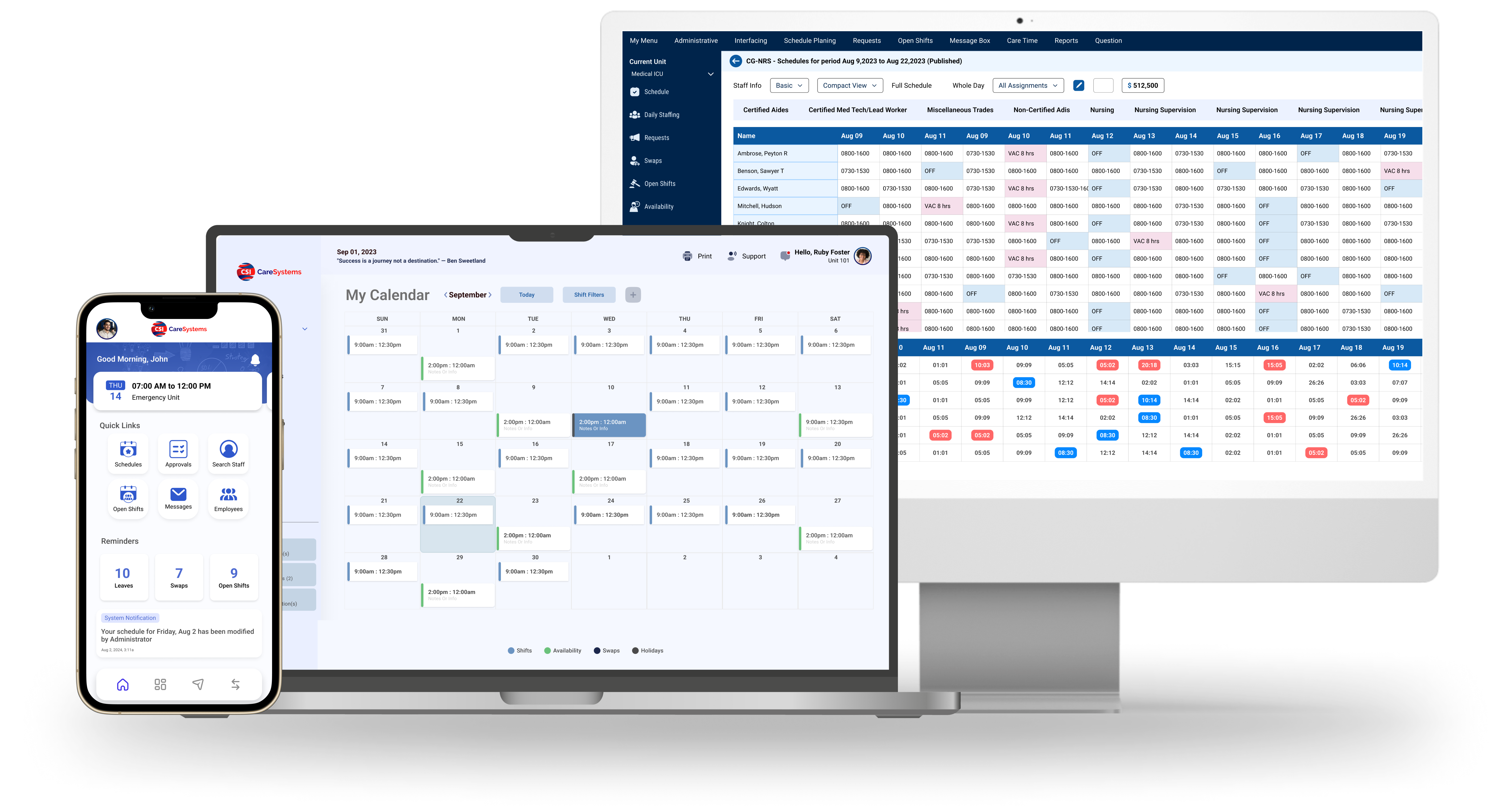
While nurse satisfaction was a big reason for buying the CareWare software from Rockville, Md.-based Care Systems Inc., there have been other benefits as well. Nurse managers have cut the time it takes to produce the schedule in half from 17 hours per scheduling period to 8.5 hours. The hospital after the first year of using the scheduling software realized a time-savings benefit of $149,000.

An unexpected benefit of the software has been easing compliance with regulations of the Joint Commission on Accreditation of Healthcare Organizations and the Texas Board of Nurse Examiners, says Ron Short, director of nursing operations.

The system tracks whether the nurses applying for a shift in a particular unit have the necessary skills. The software also serves as a central repository for nurse educational, licensing and certification information. When a nurse's license or certification is about to expire, the system automatically alerts the nurse and managers of the need to renew.

Sidebar

Honorable Mention: Automating 'hand offs' between shifts

Nurses at Provena Saint Joseph Medical Center used to take up to an hour to hand write the "hand-off" reports that updated nurses working the next shift about the treatments and status of their patients.

During this time, patients may not have been receiving care because some nurses were filling out reports and others were coming on shift and looking through the reports, says Kathy Mikos, R.N., at the 475-bed hospital in Joliet, Ill. "It was a kind of chaos," she recalls.

To streamline the process, the hospital developed an electronic voice recording system with help from the White Stone Group, Knoxville, Tenn. Now nurses dial into the system, enter their access code and the patient's medical record number and record or listen to the necessary information.

Nurses record information in a standardized format called SBAR, which covers the areas of Situation, Background, Assessment and Recommendation. Those retrieving information can skip certain sections they already know about, such as background, and can slow down a speaker's speech or speed it up.

Voice recording has eliminated errors caused by illegible handwriting, Mikos says, while speeding up the entire reporting process. Instead of taking an hour to hand-write hand-off reports, it now takes about 15 minutes to record them. "This enables me to have staff at the bedside rather than being tied up with reports," Mikos says.

The time saved has increased nurse availability for patient surveillance during shift changes. The result has been demonstrated through an improvement in response time to patient call lights and a decrease in patient falls during shift changes. Further, shift changes are quieter and patient privacy is better protected. "You used to have 20 people chattering on the floor," Mikos says.

Based on an analysis of the hand-off reporting process on two medical/surgical floors, the medical center expects an annual cost savings of approximately $550,000 and a 50% reduction in overtime once the voice recording system is fully implemented on all floors.

Executives now are exploring other potential uses for the system, such as providing up-to-date communication to patients' family members. The hospital is also considering having physicians use the system to improve the quality of their hand-off reports. Further, the system is being implemented at two other Provena Health hospitals in Illinois-Provena Covenant Medical Center in Urbana and Provena United Samaritans Medical Center in Danville.

Sidebar

Honorable Mention: Keeping track of meds across physicians

To help prevent medication errors, the nursing staff at Atlantic General Hospital wanted easy access to patients' complete medication histories, including records of drugs ordered by primary care physicians in the community. In turn, they wanted to provide complete information to area doctors.

Berlin, Md.-based Atlantic General already had its own medication reconciliation program in place to track inpatient medications. To help fund enhancement of this home-grown system to accommodate outpatient medication records from community physicians, the hospital received a $50,000 grant from the Maryland Patient Safety Center and Cardinal Health Inc., a Dublin, Ohio-based supply company. This covered 80% of the project's cost, says Colleen Wareing, vice president of patient care at the 62-bed hospital.

The 62-bed hospital developed a Web-based system so physicians in the community would not have to install any new software, says William Smith, development and integration team lead at the hospital.

The application enables community physicians and office staff to view and update the patient's medications during each office visit and also access records at any point along the continuum of care. The application also enables physicians to enter allergies and print out prescriptions instead of hand-writing them.

Atlantic General has two physician offices and two hospital-based physicians testing the new system, says Robert Yocubik, R.N., an information systems clinical analyst at the hospital.

By late February, the community medication tracking system held information on 27,200 patients, but only 1,590 were full medication records, says Robin Warnna, project manager at the hospital. More information will be added in the months ahead.

The surgical department went online with the record in February and the emergency department, the Atlantic Health Center and Berlin Nursing Home are expected to be live by the end of June.

Sidebar

Honorable Mention: Automating medication administration

A nursing I.T. initiative at Morristown, N.J.-based Atlantic Health is designed to achieve two goals: improve patient safety and increase nurse efficiency.

The delivery system has included equipment for bar-code medication administration on computer carts at two of its hospitals, says Judy Wall, director of application support in information services.

Use of the technology became paramount after Atlantic Health adopted the patient safety recommendations of The Leapfrog Group employer coalition and the Institute for Healthcare Improvement in Cambridge, Mass. Both groups called for deploying a computerized physician order entry system and a pharmacy information system.

With the new systems came an electronic bedside medication administration process that uses bar codes to verify information on medication labels and patient wristbands. Nurses use a mobile cart that includes a computer, a medication bin and a handheld scanner.

Now when nurses begin a shift, they take a computer cart and head to the pharmacy technician assigned to that floor, says Michelle Downing, R.N., nursing informatics coordinator at 637-bed Morristown (N.J.) Memorial Hospital, part of Atlantic Health. The nurses pick up medications and other supplies they will need to begin their shift.

When administering medications, a computer records scanned information and verifies that the patient is receiving the proper medications at the proper time. The application also provides the nurse with safety alerts and drug administration instructions if necessary.

Instead of handwriting their medical charts, nurses are now completing charts at the bedside using electronic medical records software on the mobile computers, says Celeste Castle, R.N., oncology unit manager at 507-bed Overlook Hospital in Summit, N.J. She's also an information technology liaison. "They're saving on average two hours and 17 minutes by charting at the bedside," she says.

When nurses first started using the bar codes last August, some were hesitant because they weren't sure how patients would react to the new processes, Castle says. "They were a little skeptical and thought the patient would feel like a loaf of bread," she says. But after explaining processes, patients accepted the new technology.

Sidebar

About the Award Competition

Health Data Management developed the Nursing Information Technology Innovation Award in collaboration with the Maryland Technology Committee and the Capitol Area Roundtable on Informatics in Nursing.

These two groundbreaking organizations are studying and advocating the use of information technology to assist nurses in caring for patients.

More information about their efforts is available at maryland.nursetech.com and caringonline.org.

The award is designed to recognize a team of nursing professionals at a U.S. health care organization (hospital, physician group practice or any other care-giving site).

It honors innovation and excellence in using information technology in the field of nursing to directly improve the quality of care/patient safety and/or promote the effective use of nursing resources.

A total of 56 organizations submitted essays to be considered for the award. These essays were reviewed by a panel of judges that selected one winner and four honorable mentions, based on their total scores.

Judges included Greg Gillespie, associate publisher/editorial, Health Data Management, and four nursing informaticists:

* Susan Newbold, R.N., associate professor, Vanderbilt University School of Nursing, Nashville, Tenn.

* Stephen Prouse, R.N., director of clinical applications, Upper Chesapeake Health, Bel Air, Md.

* Dana Womack, R.N., nursing informatics specialist, Vocera Communications, Cupertino, Calif.

* Linda Laskowski Jones, R.N., vice president of emergency, trauma and aeromedical Services, Christiana Care Health System, Wilmington, Del.


Back to the top